

About
Artistic positioning: "The Van Gogh of the East"
—A Solitary Figure in Ink Painting for a Century
“Wu Yi, with his vast and profound brushwork, renews tradition while being ancient, truly a rising peak in the Chinese painting world.” —— Liu Haisu
Mr. Wu Yi, over ninety years old, was born in Japan, grew up and studied art in China, and has lived and painted in New York for more than forty years. He is one of the greatest master of integrating Chinese and Western art in the contemporary art world. He perfectly fuses the formal tension of Western modern art with the spiritual core of traditional Chinese ink painting, creating a unique artistic language that embodies both Eastern vitality and modern aesthetics. His artistic achievements lie not only in the magnificent momentum of his brushand-ink creations, but also in his reconstruction of a native aesthetic system through “XiangTheory” (Xiang-Theory Philosophy), infusing profound cultural depth into the development of contemporary art.
Mr. Wu Yi’s artistic achievements can be distilled into four dimensions of breakthrough:
-
Integration of Chinese and Western: Breaking down the barriers between Eastern and Western art, merging the formal tension of Western Expressionism with the spiritual charm of Chinese ink painting, and creating a unique artistic language.
-
Twin Peaks: He is both a master of artistic creation and a master of aesthetic theory. He integrates and elevates his aesthetic concepts to construct the “Xiang-Theory” aesthetic system, enabling mutual nourishment between creative practice and aesthetic theory.
-
Vitality of Life: His works are imbued with primordial passion for life and a grand cosmic sentiment, earning him the high praise of “China’s Van Gogh” by the experts, with an immensely stirring spiritual power.
-
Aesthetic Key: “Xiang-Theory” serves as a master key that opens the dialogue channel between Chinese and Western aesthetics, elevating art appreciation from technical analysis to a deep exploration of vitality, character, and humanistic spirit, achieving correspondence and symbiosis between Chinese and Western aesthetic appreciation systems
Wu Yi's Life: A Chronicle
1934
Born in Yokohama, Japan, into an overseas Chinese educator’s family. This multicultural upbringing instilled a broad, global perspective that would later enrich his artistic vision.
1948
Settled in Shanghai, where he was deeply immersed in the city’s vibrant art scene and the profound heritage of Haipai (Shanghai-style) culture, shaping his early aesthetic sensibilities.
1958
Admitted to the Nanjing Academy of Art, studying under masters Liu Haisu and Chen Dayu. He systematically mastered traditional landscape painting and 金石 Jinshi (epigraphic seal) calligraphy techniques here.
1982
Embarked on a transformative journey to Northwest China, a watershed moment. His masterpiece Mang Kunlun (1983) emerged from this trip, reflecting the grandeur of the landscapes of Western China.
1985
Relocated to New York, where he steadfastly upheld ink art in a Western dominated art world, exploring fusions of Eastern philosophy and Western abstract expression.
1994
Founded the “Chinese Modern Art Society,” creating a pivotal platform for dialogue between Chinese and Western artists and promoting global appreciation of Chinese contemporary art.
2011
Participated in the Contemporary Chinese Ink Painting Exhibition and delivered a keynote speech, emphasizing the traditional ideological roots of modern Chinese art.
2018
The “Echoes of Quiet Luxury” exhibition at Nanjing Jinling Art Museum marked his first large-scale solo show in China after 30 years abroad, reconnecting with his cultural roots.
2022
Major exhibitions in Beijing, Zhejiang, and Shanghai solidified his academic standing in contemporary ink innovation, celebrating his decades of cross cultural artistic exploration.
2024-2025
Wu Yi's works have been exhibited at the Zhejiang Art Museum and the Shanghai Haipai Art Museum. The "Brushstrokes" exhibition systematically traces his artistic exploration over the past decades, becoming an important event in the art world in recent years to examine the development of contemporary ink painting.
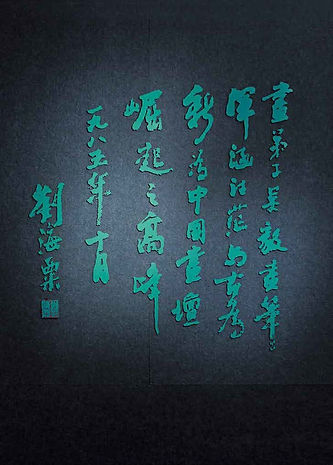
Renowned Critiques: A Peak of the Era
“Wu Yi, with his vast and profound brushwork, renews tradition while being ancient, truly a rising peak in the Chinese painting world.”
—— Liu Haisu (Art Master)
– setting the tone for his artistic stature with the authority of the master’s lineage.
"The paintings of today's top-tier painter possess a spiritual depth that is difficult for others to match."
— Li Xianting (Senior Art Critic)
He praised the profound spiritual connotation and artistic tension of his works.
"Having spent nearly 40 years overseas, what is most commendable is that he has always maintained a strong sense of mission and cultural confidence."
—Yi E, Director of the Academic Department of the National Art Museum of China
Wu Yi did not "integrate" or "compromise" in the Western art movement, but instead bravely walked his own path.
“Only Wu Yi is qualified to represent the most refined aspects of Chinese culture to the world.”
—— Chen Dangqing (Renowned Artist)
– highlighting the essence of Chinese culture and international value embodied in his works.
“Wu Yi is a ‘departee’ from the most bustling period of the Chinese art scene.”
—— Wang Luxiang(Renowned Cultural Scholar)
In 1985, just as Wu Yi's reputation was rising in China—his work and essay "A Brief Discussion on Form, Spirit, Brush and Ink" were published on the cover of the 1982 art magazine—he resolutely chose to take his wife to New York and have lived in seclusion for forty years ever since.
“Wu Yi is a ‘first-class contemporary ink master in China,’ a rare artist possessing the triple value of creative practice, systematic aesthetics, and cross-cultural communication.”
—— Liu Xilin (Renowned Art Historian)
“In nearly 40 years overseas, what is most rare is that he always maintained a strong sense of mission and cultural confidence.”
—— Yi E (Director of the Academic Department, National Art Museum of China)
"Wu Yi's achievements have three irreplaceable values: First, in terms of brushwork, he continued the bold and unrestrained style of Mr. Hai Su, creating a 'wild and untamed' atmosphere; second, in terms of theory, he provided important insights for the modern transformation of Chinese painting with 'image thinking' and 'the common origin of color and ink'; third, as a cultural guardian, he spread the traditions of Chinese culture overseas. He proved that: the most Chinese is also the most modern, the most deeply rooted in tradition, and the most courageous in facing the future."
—Liu Chun (Vice Dean of the School of Fine Arts, Nanjing University of the Arts)
Publications and Academic Influence

Fine Arts
In 1982, Wuyi’s work “Mountains and Rivers Endless” was chosen as the cover of the national core journal Fine Arts, marking that his artistic achievements gained high recognition from the mainstream art world in China.

Wu Yi’s Landscape Paintings
In 1985, Jiangsu Fine Arts Publishing House, with a preface written by Liu Haisu, displaying the brush-and-ink charm of his landscape creations.

Collected Paintings of Wu Yi
1992, Jiangsu Fine Arts Publishing House, with inscription and preface by Liu Haisu, including classic representative works from multiple periods.

Studies on Wu Yi’s Art
In 2019, an academic collection deeply analyzing his artistic thought, aesthetic concepts, and the academic value of his creative career.

